


Parallax as Spatial Mediation
Configurational and Luminous Dynamics in Kiasma Museum’s Visitor Navigation
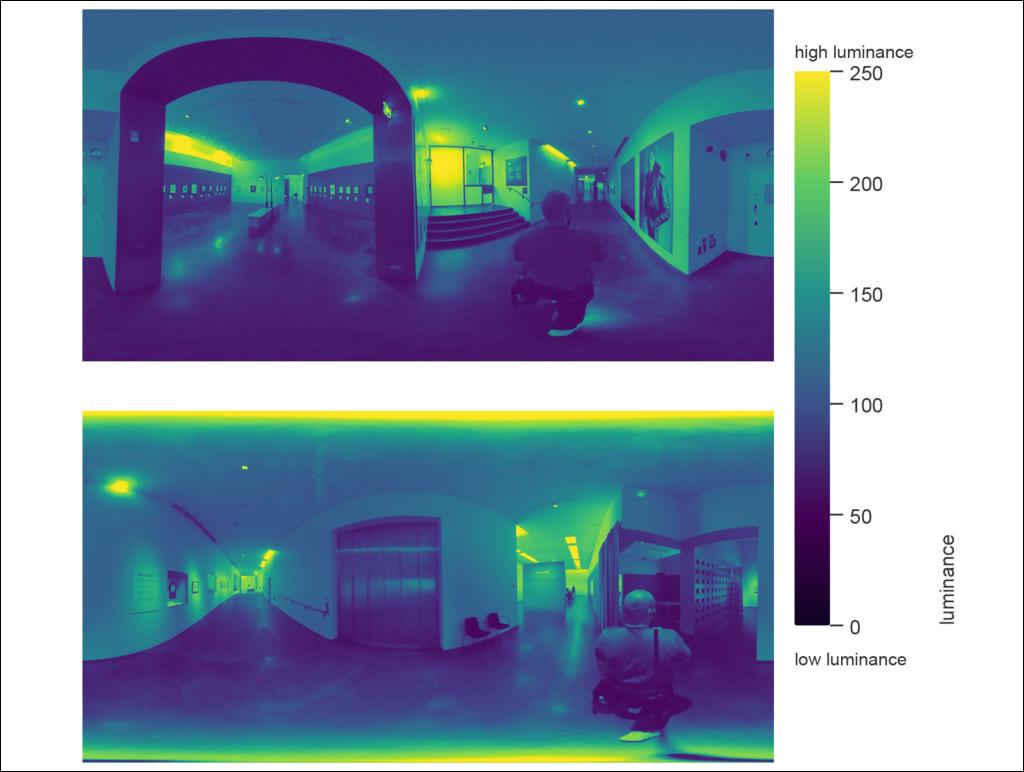
In contemporary museum design, architects increasingly treat spatial experience as a medium of visitor engagement, yet movement is often reduced to a problem of routing and orientation rather than recognised as engagement in its own right. This study shows how Steven Holl’s parallax operates as a motivational mechanism at the Kiasma Museum of Contemporary Art. Parallax, a phenomenological and ecological construct, is examined through oblique thresholds, overlapping perspectives, and layered illumination. Integrating phenomenology, ecological psychology, and spatial configuration analysis, this study links embodied perception to measurable spatial properties. Spatial relations were quantified using space syntax—axial line analysis, justified graphs, and isovist analysis—alongside luminance and visual saliency mapping of Kiasma’s second and third floors. The results reveal a dominant ring structure in which visibility tightens at thresholds and views shift continuously along the route. Pronounced brightness gradients accompany these transitions and intensify perceived change along the sequence. These coupled spatial and luminous strategies may encourage exploratory navigation, positioning wayfinding as integral to the museum experience. This study argues that parallax links spatial configuration to embodied engagement, emerging as a perceptual effect produced through the interaction of spatial layout, luminous modulation, and bodily movement rather than functioning as a fixed design principle.

While the decolonial turn in museum studies has focused primarily on curatorial practice, less attention has been paid to the role of architectural space in shaping such encounters. This paper…
Museum architecture shapes how knowledge is encountered. This article develops the concept of epistemological decentralisation to describe spatial configurations that resist privileging a single…
In contemporary museum design, architects increasingly treat spatial experience as a medium of visitor engagement, yet movement is often reduced to a problem of routing and orientation rather than…