


Between Seeing and Moving: A Sequential Isovist Analysis of Liminal Spaces at the Kiasma Museum of Contemporary Art
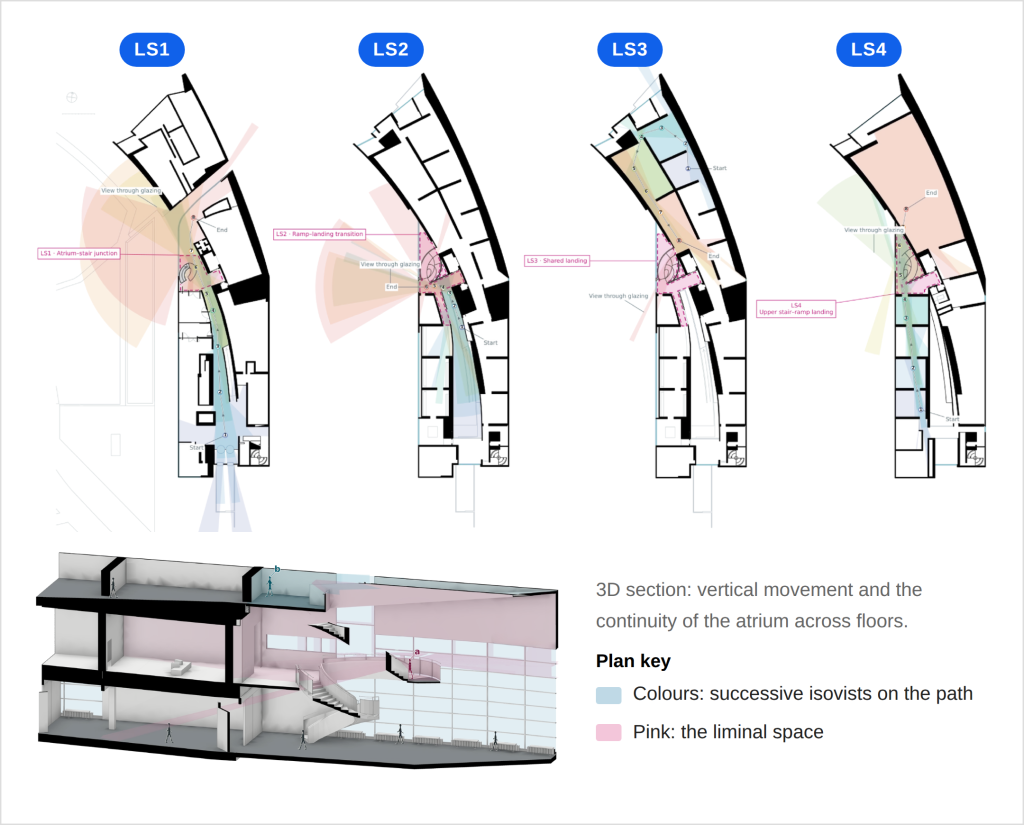
Visitors encounter museums through movement, as galleries, routes, and levels become visible and accessible from successive bodily positions. Yet, stair approaches, landings, balconies, and gallery thresholds are often treated as residual connectors rather than as spaces that help stage museum sequences. This study examines that role through eight selected liminal conditions at Steven Holl’s Kiasma Museum of Contemporary Art, Helsinki: four spiral-linked spaces, two atrium balconies, and two gallery thresholds. Grounded in embodied, ecological, and enactive accounts of perception, the study analysed eight paths using sequential isovist profiles interpreted alongside plans, sections, and observations. The transitions reorganise visibility and locomotor access in distinct ways along the route rather than sharing a common metric pattern. Spiral-linked spaces relate local movement to a recurring vertical circulation system, balconies provide visual relations across levels while withholding direct movement between them, and gallery thresholds withdraw one gallery setting and establish another progressively or abruptly. These findings show that spaces commonly treated as circulation can prepare, connect, separate, withdraw, and disclose successive museum settings. Sequential isovist analysis describes how this configurational work unfolds, specifying permanent environmental conditions relevant to embodied spatial cognition and to museum and exhibition sequencing, without taking geometry as evidence of experience or curatorial intention.

Visitors encounter museums through movement, as galleries, routes, and levels become visible and accessible from successive bodily positions. Yet, stair approaches, landings, balconies, and…
While the decolonial turn in museum studies has focused primarily on curatorial practice, less attention has been paid to the role of architectural space in shaping such encounters. This paper…
Museum architecture shapes how knowledge is encountered. This article develops the concept of epistemological decentralisation to describe spatial configurations that resist privileging a single…