



Electrochemical Determination of Riboflavin using a Poly(Titan Yellow) Modified Carbon Nanotube Paste Electrode in the Presence of Dopamine
Abstract
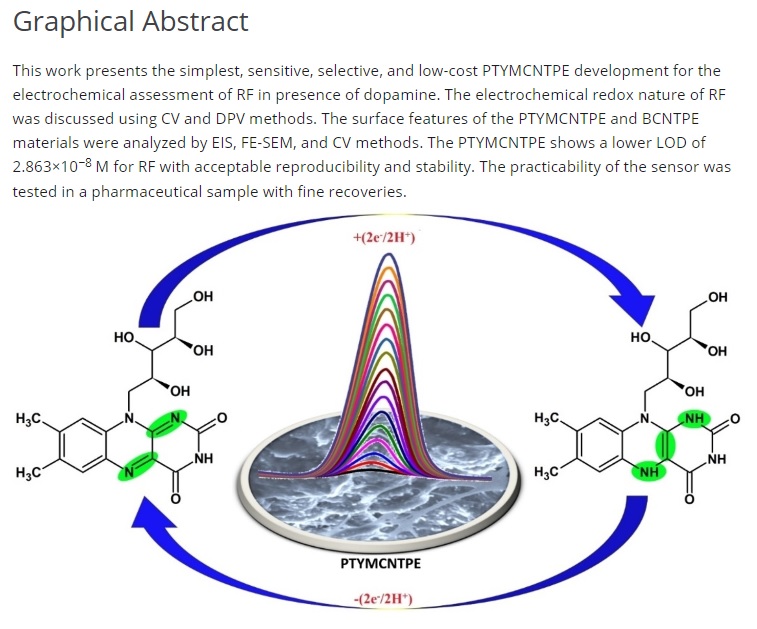
The bare carbon nanotube paste electrode (BCNTPE) is a helpful base material for the construction of different electrometric sensors for analytical purposes. The BCNTPE was chemically modified with a polymerization process using titan yellow (TY) dye for the selective determination of riboflavin (RF) in presence of dopamine (DA). A poly(titan yellow) modified carbon nanotubes paste electrode (PTYMCNTPE) has been constructed by a simple and eco-friendly procedure. The PTYMCNTPE material surface was examined by cyclic voltammetry (CV), Field emission-scanning electron microscopy (FE-SEM), electrochemical impedance spectroscopy (EIS), and differential pulse voltammetry (DPV) methods. The outcomes suggested that the modified electrode displays high electrocatalytic action for the redox reaction of RF. The limit of detection (LOD) and limit of quantification (LOQ) for the detection of RF were found to be 2.679×10⁻⁸ M and 8.932×10⁻⁸ M, correspondingly. The proposed sensor was effectively applied for the determination of RF in a pharmaceutical sample.
نوع عمل المنشور
Research
مزيد من المنشورات

Optimizing electronic structures and incorporating additional active sites in metal oxides can significantly enhance the performance of the oxygen evolution reaction (OER), which is a pivotal…
2026
تم النشر فى:
Elsevier
First-principles calculations were performed to analyze the effects of oxygen vacancies (Vo) and the combined effect of Vo and copper doping on layered perovskites ACr2O7 (A = Be, Mg, Ca…
2026
تم النشر فى:
Elsevier
Accurate thermal modeling is essential for predicting the behavior and ensuring the safety of lithium-ion battery cells and modules. In this study, a comprehensive electrothermal model is…
2025
تم النشر فى:
Elsevier